
Abdelkader Benchamma
Solastagia: Archeologies of Loss – The Power Plant, Toronto


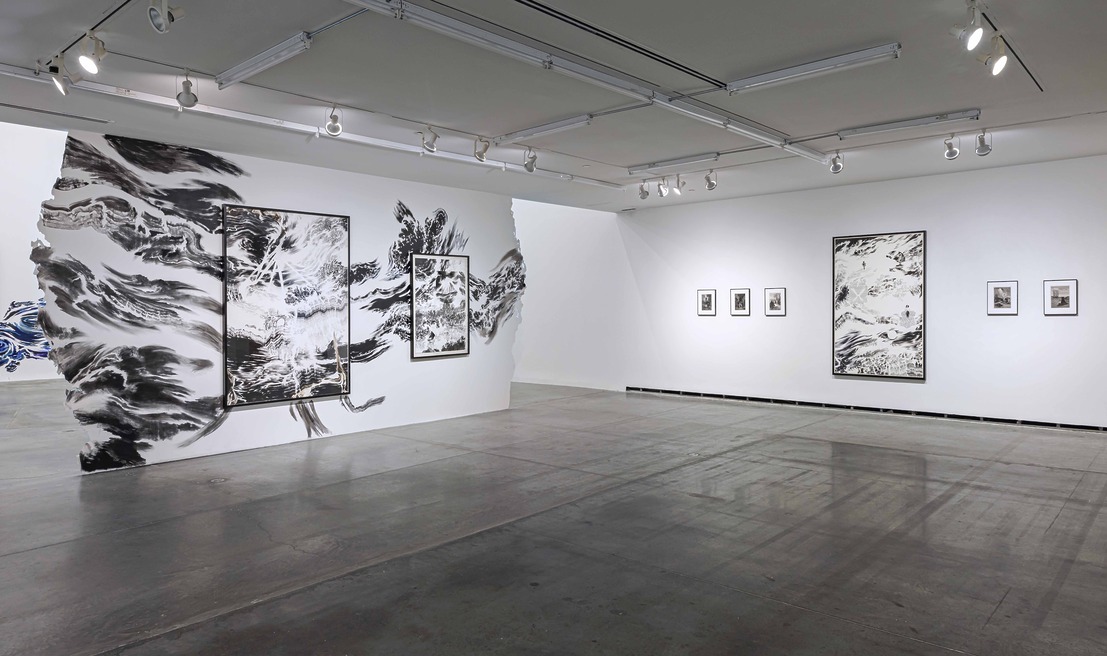
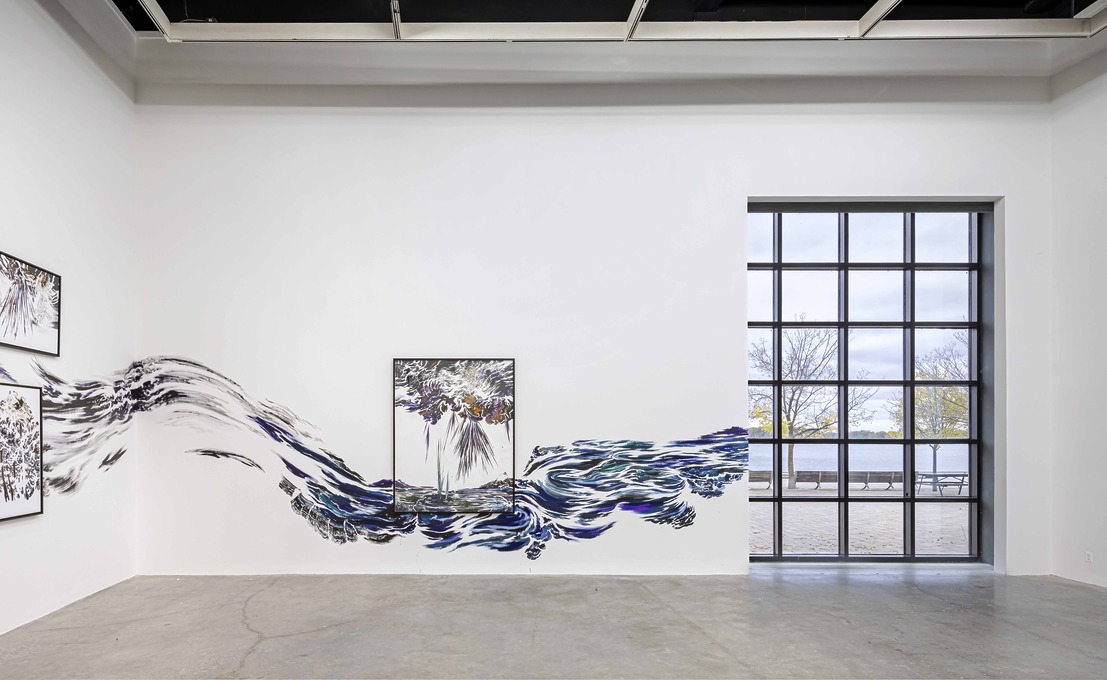
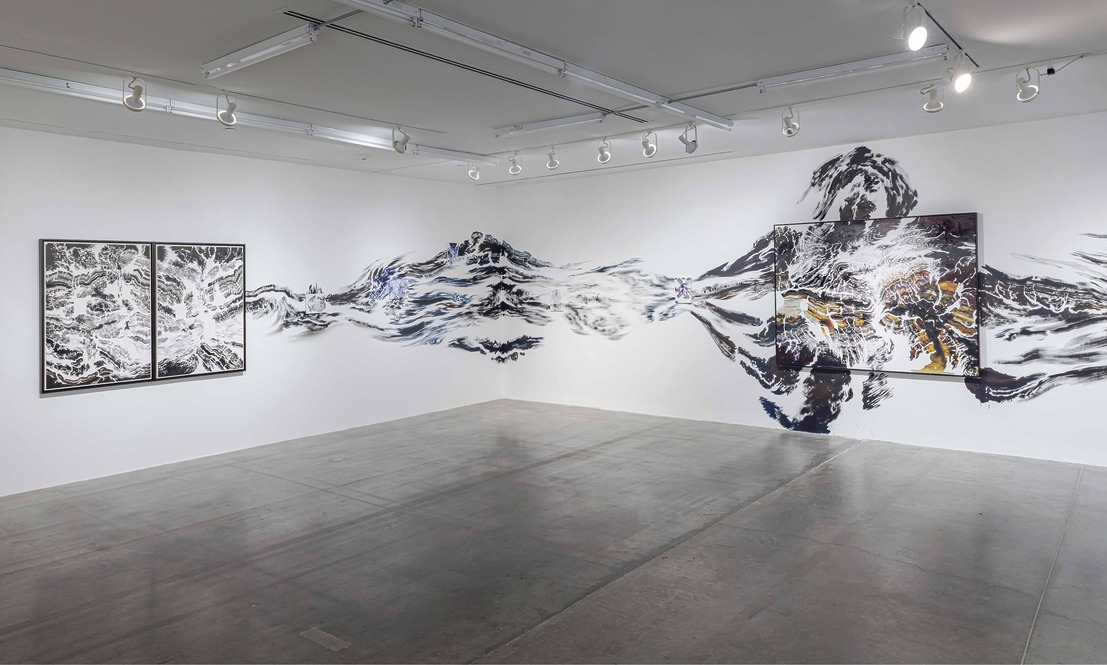
Envisioned as a geological epic of our universe, Solastalgia: Archaeologies of Loss is a solo exhibition by French artist Abdelkader Benchamma that conjures enigmatic worlds and elemental forces at the precipice of transformation, evoking a yearning for worlds yet to be. Like an archaeologist, Benchamma unearths symbols–found in ancient mythologies and legends–that humanity has from its earliest moments inscribed onto the land, sky, and celestial bodies. In doing so, he creates an elusive topography of dreams that centres our spiritual ties with nature, reclaiming our interconnectedness with the world.
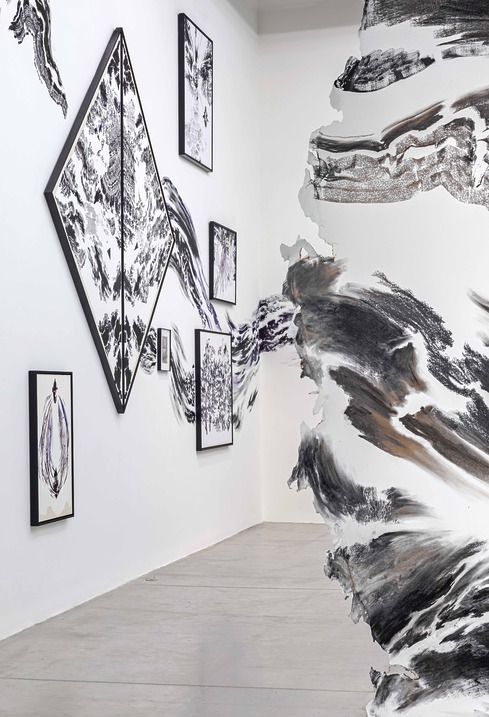
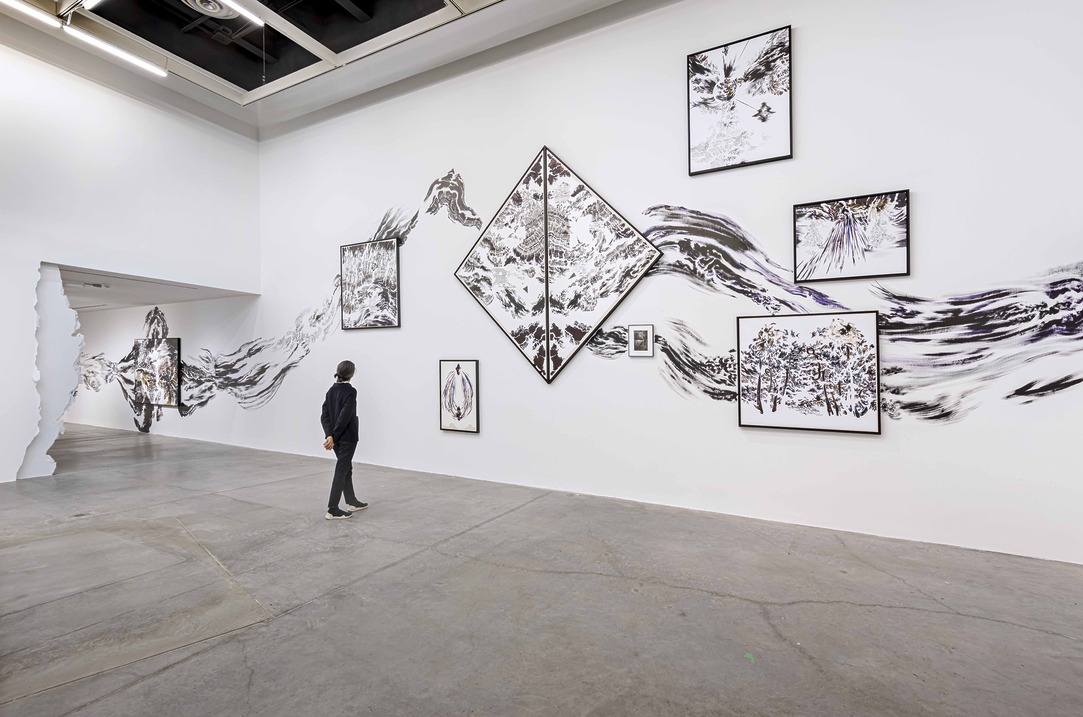
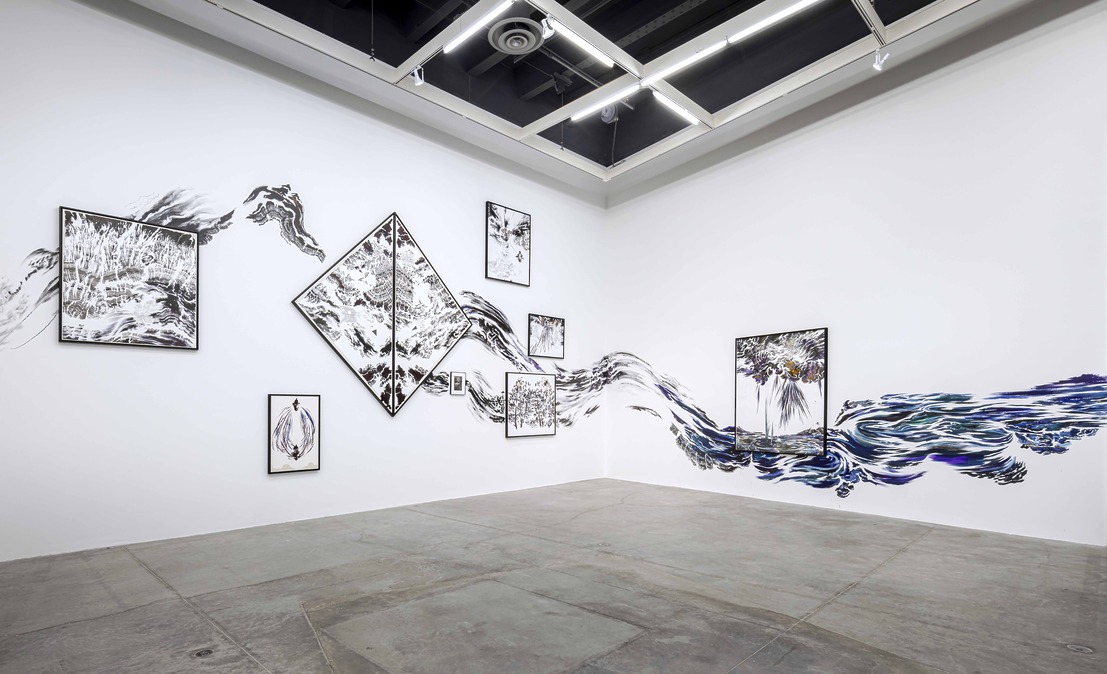
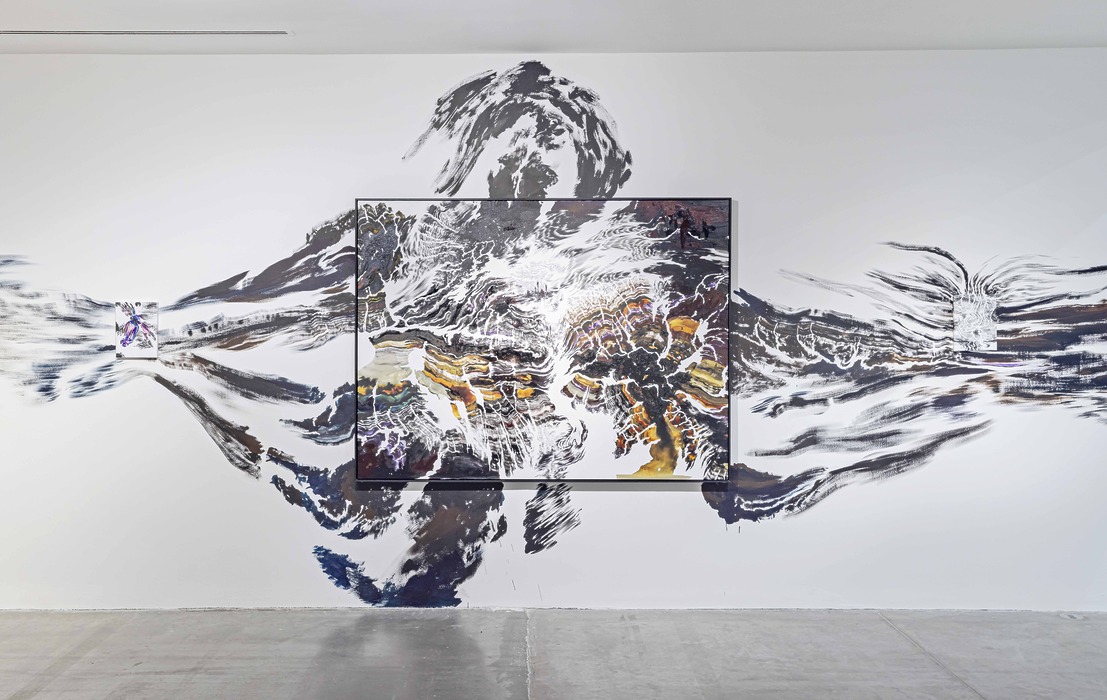
Gestural and lyrical, his primarily monochrome murals, drawings, and installations, depict undulating terrains, tectonic movements, and gravitational forces that harness the dynamism of the universe. Indebted to the language of physics, his linework is an embodiment of the arrow of time, marking a fateful trajectory of perpetual motion. Immersed in the themes of natural philosophy, geology, astronomy, alchemy, art history, and existential literature, his works reflect an encyclopedic repertoire of interests. At times an architect of unruly universes, and an archaeologist of dormant memories, his elusive works unravel the relationships between humanity and the cosmos, both equally endowed with the generative powers of creation, change, and destruction.
Embraced in light and darkness, Abdelkader Benchamma’s as above, so below is an allegorical wall drawing that evokes the grandeur of geological and symbolic timescales. The mural as above, so below is envisioned as a cave harbouring elemental forces, an allusive landscape of primordial memories, and a vortex that thrusts forward the currents of time. This enveloping drawing brings together a dynamic set of natural phenomena—tectonic chasms, tempestuous whirlpools, and gravitational forces—to create an enigmatic and evanescent landscape. As if emerging from an ethereal realm, lines swell, collide, and dissipate, expressing movement bound in an eternal cycle. The work’s title is borrowed from a phrase found in the Emerald Tablet, a hermetic text of ancient Arabic or Greek origins that revealed the bonds between the celestial and terrestrial spheres.
Since time immemorial, humanity has used caves as sacred sites of cosmological rituals, burial grounds, and for murals that display our earliest forms of artistic expression. They are living archives with layers of memories inscribed by human activity accumulated over time. If the absence of light is the defining feature of caves, which are home to complex forms of life, darkness can be imagined anew as a life-giving force. Benchamma’s work in the Fleck Clerestory exists in a spiritual dimension, where darkness becomes a conduit for enlightenment, creating an inner sanctuary, a chamber of latent memories, taking us back to the genesis of the cosmos.
The artist

Born in 1975 in Mazamet (France), Abdelkader Benchamma lives and works in Paris and Montpellier.
A graduate of the Beaux-Arts de Montpellier and the École des Beaux-Arts de Paris, his preferred medium is drawing.
Nourished by literature, philosophy and astrophysics, his drawn installations continually challenge exhibition spaces, becoming, in his words, “spaces of resonance”, conducive to the summoning of memories, both individual and collective, geological and spiritual.
His vast ephemeral frescoes are painted directly onto walls with ink, transforming architecture into an otherworld, a world of flux and mental landscapes, between the recognizable and the indiscernible, on the border between the physical and the symbolic. Reflecting on the workings of perception, his works explore our systems of knowledge, the survival of myths and beliefs, but also reminiscences, retinal or neuronal persistence, whether on museum walls or sheets of paper.
