
David Smalling
Flemish Light
Following a successful exhibition at Templon New York last Spring, Flemish Light is the first presentation in Europe by Jamaican-born and New York-based artist David Smalling.

The exhibition brings together in Brussels recent oil on panel paintings drawn from Mannerism, Dutch Golden Age, and Flemish still lives, exploring the contradictions and unspoken codes that govern inaccessible social and cultural worlds.
Born in 1987 in Kingston, Jamaica, Smalling lives and works in New York. He studied Mathematics at Yale University, where he also trained at the Yale School of Art, and holds a Ph.D. from Harvard University. His paintings reflect a careful, deliberate approach, attentive to the physical qualities of oil paint, precise in composition, and engaged with social codes and symbols.
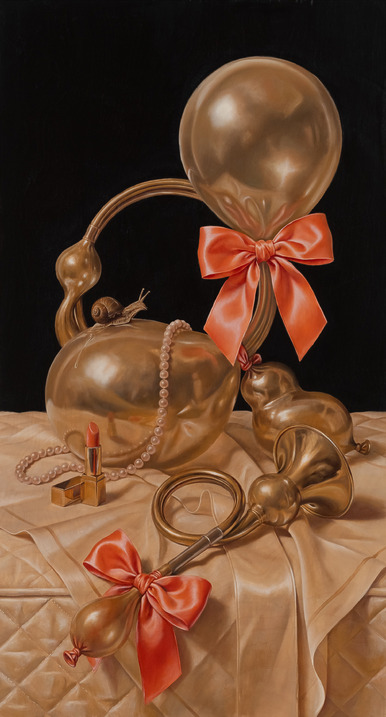
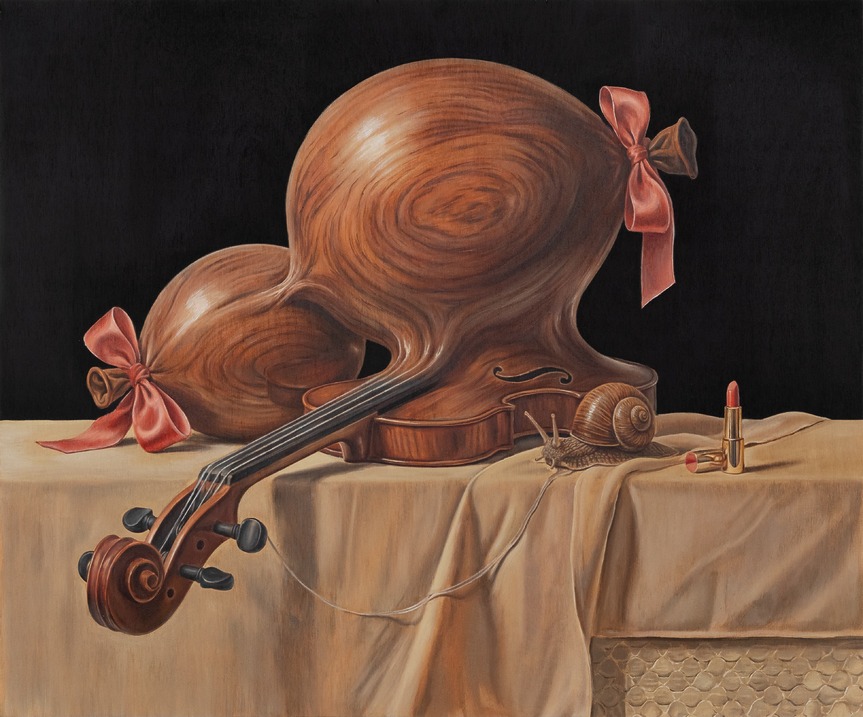
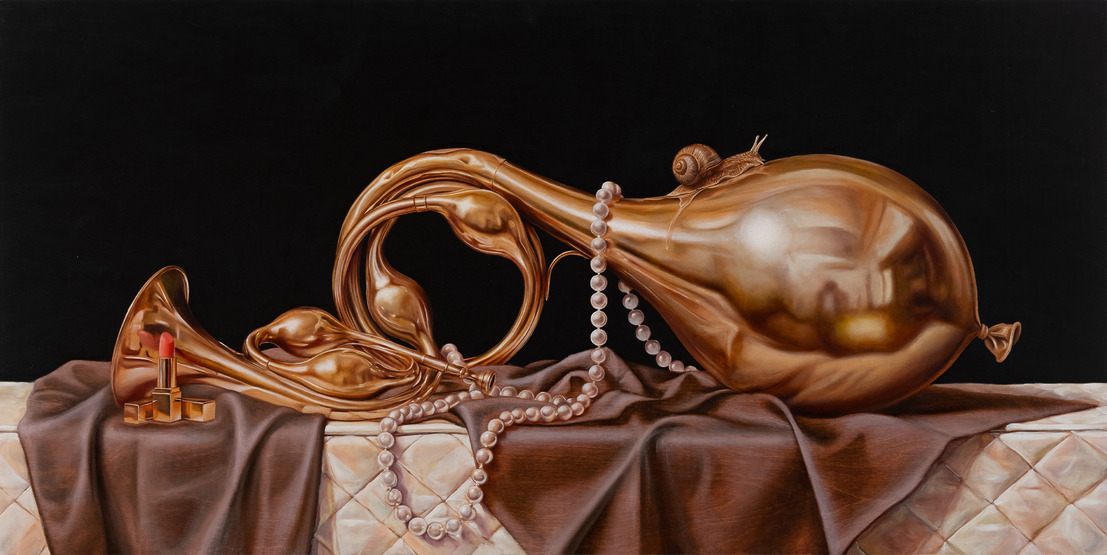
Flemish Light brings together at the gallery’s Belgian space a selection of recent paintings that stage a dialogue between the material and optical traditions of painting in the Netherlands. Early Dutch painters harnessed oil paint’s capacity for translucency, opacity, and fine detail to distinguish cloth from metal, glass from skin, and reflected space from the room that contains it. In seventeenth-century Antwerp, still-life painters made accumulation itself a pictorial subject. Smalling redirects this descriptive intensity toward scenes emptied of figures, finding a unique resonance with this region’s history of painting for the occasion. Wind instruments take on the sealed volume of organs, silk bedding rises into architecture, and objects assume a position ordinarily given to sitters. Human presence is registered indirectly, through possession, reflection, and the remainder of a meal.
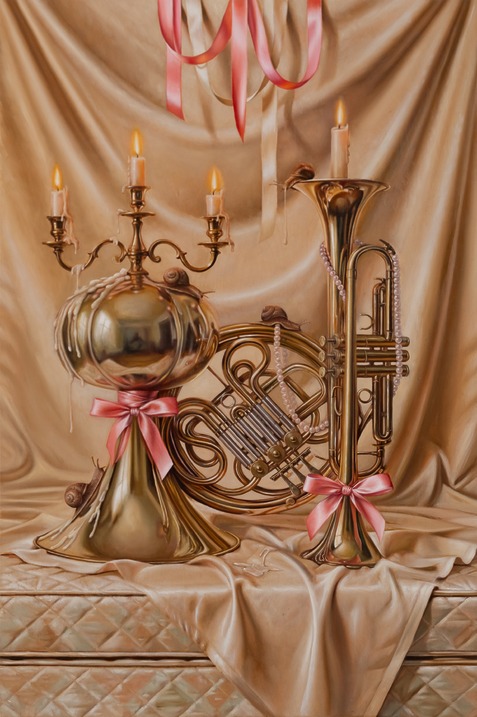
The work Tallow (2026) depicts a stack of worn and satin-finished mattresses arranged loosely, the base and top of which are not visible. The title evokes the rendered animal fat historically used to make candles, making light inseparable from the expenditure of a body, and thus introducing a beastly element in the composition. In the center, the chandelier casts a soft, aesthetic light. But after the initial sense of pleasure, one notices the wax dripping toward the lower part of the painting, shrouded in shadow. In the absence of sleepers, the burning tapers register time as a process of depletion.
Supplemental Course (2025) suggests a lesson, a staged meal, a formal evening come to an end. The mattresses, a symbol of comfort, are once again stacked, but the stacking itself precludes rest. “Supplemental” describes an addition that no longer completes the arrangement but overwhelms it. Provision continues past the point of need, and abundance begins to undermine the very structure meant to contain it.
Across the exhibition the paintings remain materially seductive even as something bodily and quietly threatening gathers beneath the surface. This tension between aesthetic satisfaction and the grotesque prevails through Smalling’s exploration of ordinary objects and their symbolic charge.
Taken together, these works turn still life into a way of placing material in time. Smalling’s dialogue with painting traditions of the Netherlands rests not on quotation but on a shared attention to surfaces through which appetite, status, mortality, and exchange become visible. The feast migrates from the tabletop to the entire structure of the interior; consumption becomes the expenditure of light, pigment, domesticity, and time. Light is assembled through successive layers of paint, caught and redistributed by brass, silver and pearl, and sustained through the depletion of candle matter. It gathers gradually, never without a cost.

Supplemental Course
The artist

Born in 1987 in Kingston, Jamaica, David Smalling lives and works in New York City. He studied Mathematics at Yale University, where he also trained at the Yale School of Art, and holds a Ph.D. from Harvard University.
Drawing from the tradition of Mannerism and the Dutch Golden Age, Smalling’s paintings examine how contemporary social codes and gender norms shape identity and behavior. Through carefully constructed domestic and ceremonial scenes, he explores themes of belonging, aspiration, and restraint, questioning the roles we inherit and perform.
