Abdelkader Benchamma
Signs and Wonders
Abdelkader Benchamma returns this spring to Galerie Templon for his fourth solo show, Signs and Wonders.
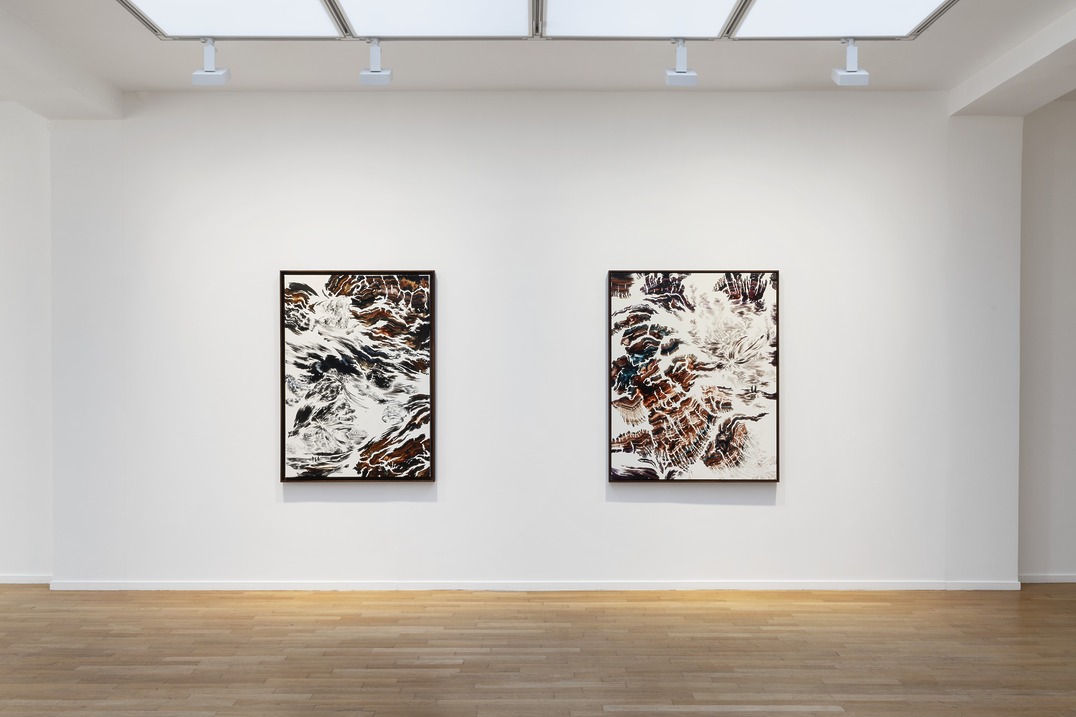
Subtly playing with shifts in scale and pareidolia, his works turn surfaces into resonant spaces where currents, figures, turbulence, cosmic realms, and inner landscapes unfold.


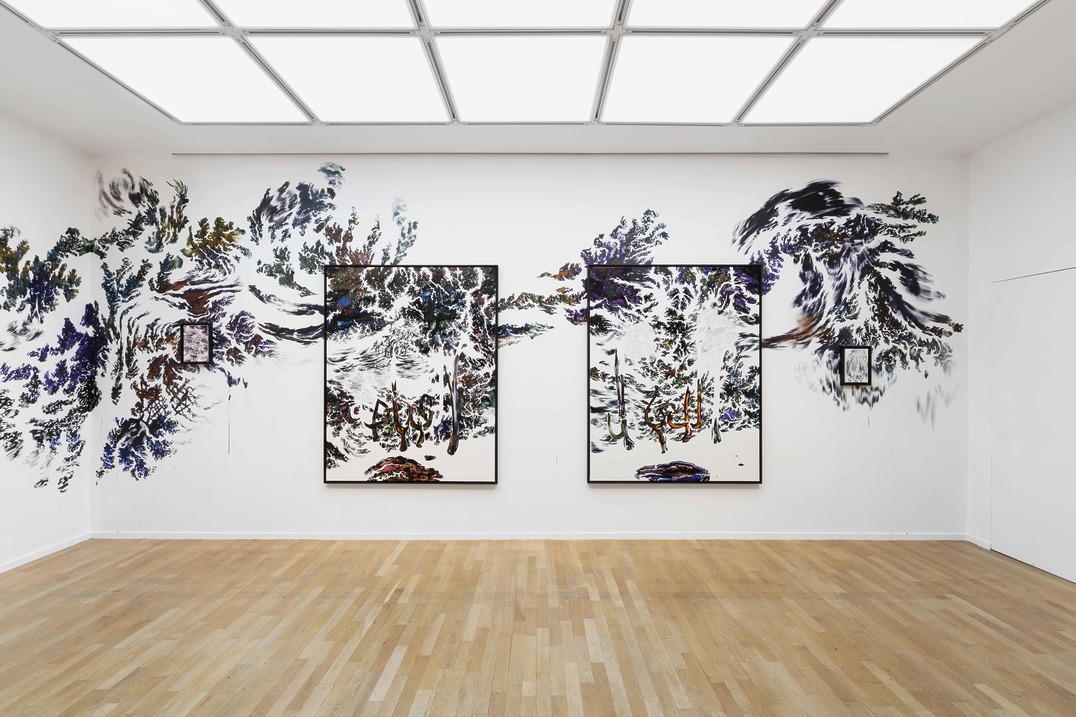
Long associated with black-and-white compositions and ephemeral installations, his practice now foregrounds color, deployed in ambitious new formats that hover between mural and painting. Benchamma has developed a visual language rooted in a taut, hypnotic style of drawing, shaped by literary, ethnographic, and esoteric influences drawn from the vast body of texts and images he has been collecting and expanding over the years. These diverse sources nourish his work and seem to exist at the threshold of the known world – that shifting terrain between science and magic – like an elusive atlas of invisible realms.
The works on view draw inspiration from two books that hold particular significance for the artist. The Kitab al-Bulhan (The Marvels of Created Things and the Curiosities of Existing Things), better known as The Book of Wonders, is a 14-15th century Arabic manuscript from medieval Mesopotamia, believed to have been written by Abd al-Hasan al-Isfahani. In its singular illuminations, astronomical observations appear alongside magical talismans, architectural marvels, and depictions of jinn – beings made of smokeless fire, invisible entities akin to spirits that may visit our dreams. Centuries before the first European scientific atlases, the Kitab al-Bulhan captivates through its poetic force, allowing the visible and invisible to coexist in enigmatic images that suggest a reality in constant flux, forever resisting complete comprehension.
In a different vein, the 16th-century German engravings of the Book of Miracles continue to fascinate the artist. This anonymous manuscript, which recounts supernatural phenomena, interweaves biblical narratives, folklore, and apocalyptic visions. In these strikingly modern images, the relationship between the heavens and the earthly realm is deeply fraught: the phenomena depicted become omens of catastrophe, harbingers of apocalypse threatening humankind. Once again, the unknown unsettles, reigniting fear of what lies beyond human understanding.
Benchamma connects these celestial anxieties to contemporary narratives that uncannily echo them—such as U.S. congressional hearings warning of potential extraterrestrial threats. Across centuries, belief systems persist, adapting to the technologies of their time while replaying the same ancient fears.
Conceived as the pages of a vast manuscript, Signs and Wonders transforms the gallery into an in-between space: a fertile, ever-shifting organism threaded with passages to other worlds, oscillating between unease and a longing for re-enchantment. The illuminations, bearers of memory, break free of their frames to infiltrate and redefine the space; pages where shimmering stars seem to morph into drifting drones or UFOs, and where, miraculously, the veneration of trees and stones endures.
This exhibition marks a pivotal moment in the artist’s career. In September 2026, Abdelkader Benchamma will begin a residency at Villa Albertine in New York, where he will notably explore the archives of the American Society for Psychical Research (ASPR). This exceptional collection, devoted to parapsychological phenomena, will further extend his investigation of the invisible and its representations.

Entre la terre et le ciel
The artist

Born in 1975 in Mazamet (France), Abdelkader Benchamma lives and works in Paris and Montpellier.
A graduate of the Beaux-Arts de Montpellier and the École des Beaux-Arts de Paris, his preferred medium is drawing.
Nourished by literature, philosophy and astrophysics, his drawn installations continually challenge exhibition spaces, becoming, in his words, “spaces of resonance”, conducive to the summoning of memories, both individual and collective, geological and spiritual.
His vast ephemeral frescoes are painted directly onto walls with ink, transforming architecture into an otherworld, a world of flux and mental landscapes, between the recognizable and the indiscernible, on the border between the physical and the symbolic. Reflecting on the workings of perception, his works explore our systems of knowledge, the survival of myths and beliefs, but also reminiscences, retinal or neuronal persistence, whether on museum walls or sheets of paper.